
Terminology
This page includes a list of products, technical terms and phrases used throughout our web site, and sometimes by our representatives. We hope this page will help you gain a better understanding of the various terms we use and, should you need any further clarification of any kind, please feel free to ask us.
- Basic Terms
- What Makes Up a Branding Iron?
- The Branding Head
- Styles of Branding Heads
- 3 Ways to Connect a Branding Head
- Types of Branding Irons
- Cattle Branding Irons
- Outlined vs. Filled
- Vector vs. Raster Images
- Branding Head Relief
- Surface Area
-
Branding
Making a permanent mark primarily by burning and sometimes freezing the area being marked.
Branding Iron
A complete tool that’s heated up for permanently branding various materials that respond favorably to heat. Some branding irons are used exclusively on livestock. The head of a branding iron is the part that features the desired image (such as a logo, a design or text) and, when heated up and brought in contact with the surface of certain materials, the mirror image is then “transferred”.
Dwell Time
The length of time (the number of seconds) the branding head is kept in contact with the surface being branded.
Recovery Time
The length of time (the number of seconds or minutes) it takes for a branding head to reach a certain degree of heat between applications.
Temperature Control Units
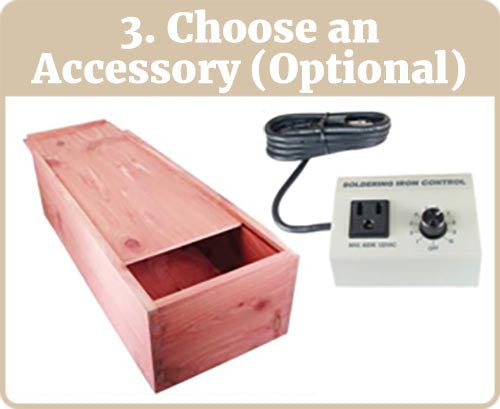
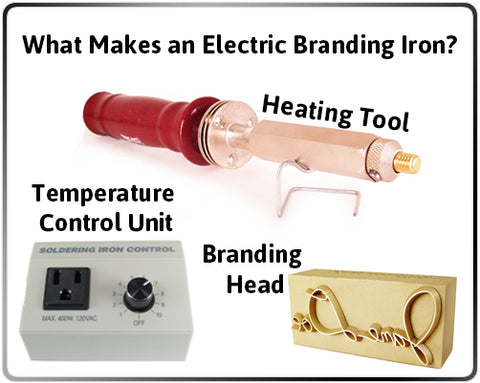
A Temperature Control Unit (TCU) regulates the amount of electricity that flows through it. When connected to an electric branding iron, the user can control the temperature. The temperature control unit enables continuous and consistent branding and also protects and prolongs the life of the electric branding iron.
-
What makes a Custom Branding Iron?
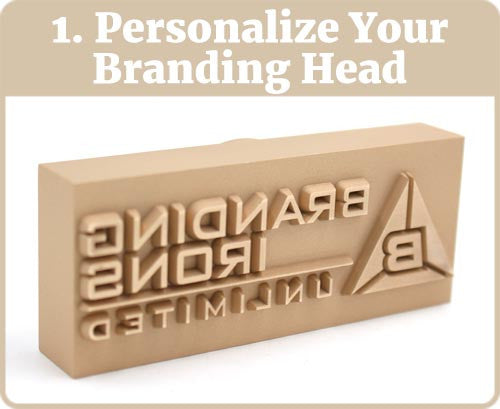
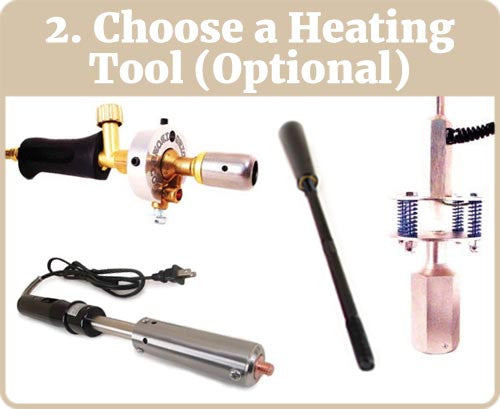
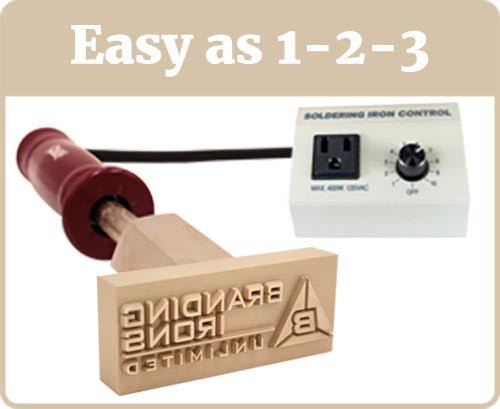
A branding iron is comprised of two main parts, the Branding Head and the handle or Heating tool. Some branding irons, such as Cattle and Steak irons, have these two parts permanently connected. The heating tool is the part most folks refer to as the “handle”. It is the part of the branding iron that is connected to the branding head for the purpose of collecting or generating heat. It can be a metal rod that is connected to the branding head for heating over open flame, or it can be a propane branding tool designed to connect to a branding head. A “handle” or heating tool can also be an electric tool that generates and delivers heat to the branding head. - The branding head is the part some folks refer to as the “iron”. It is the part of the branding iron that gets heated up as it features the desired image, such as a cattle brand, a logo, a design or text (letters, numbers, symbols, etc.).
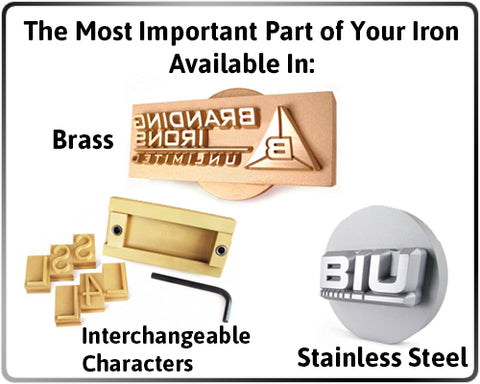
Branding heads for marking various materials are usually made of brass. We refer to such branding heads as “Multi-Purpose Branding Heads”. Branding Irons Unlimited also produces stainless steel branding heads intended for branding food products. These kind of branding heads are deep engraved (milled) with the desired image requested by the customer, such as a logo.
Most branding heads are interchangeable and compatible between fire-heated and electric heating tools. The branding heads we make for our Pro-1000 Propane Branding tool are designed to connect only to this specific heating tool.
NOTE: Some refer to a branding head as a “branding die”, a “branding iron”, a “brander” or a “heat stamp”. Other terms may also be used, but the term we use for the image part of a branding iron is the “Branding Head”.
Many branded marks typically appear as burned marks on materials such as wood, cork, card-stock and canvas, to name a few. On other materials such as certain kinds of leather, when using low heat, a branded mark can resemble a somewhat impressed mark. Another example of a branded mark that does resemble a burned mark is when certain kinds of plastics are branded. This is because a heated branding head melts the plastic, leaving an impressed mark.
- A branding head can be designed to suit many needs. Size, product surface, surface curvature (see concave and convex), and type of metal the head is made of and relief (see Branding Head Relief) can all be altered for marking particular surfaces and materials.
Brass Branding Heads
A brass branding head is made of Yellow Brass (70% Copper / 30% Zinc) and is the primary metal for producing most branding heads. Brass branding heads are suitable for marking a wide range of materials.
Stainless Steel Branding Heads
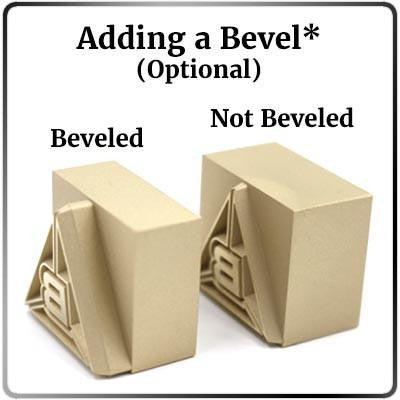
A stainless steel branding head is primarily for branding food products, such as burger buns, as it does not contain lead. We engrave our stainless steel branding heads with the same level of care and attention that we put into our brass branding heads with a standard engraving depth of 3/32". When selecting a stainless steel branding head a bevel is automatically included. This helps prevents background marks on food products that are usually softer than other (non-edible) products made of materials such as wood and plastic.
Slotted Head Holder for Interchangeable Characters
A slotted head holder for interchangeable characters is a brass or stainless steel branding head with a milled channel called a T-Slot. When more than one line (of interchangeable characters) is needed for obtaining 2 or 3 lines per branded mark, double and triple T-Slot channels are milled into the holder. The slotted head holder houses individual brass or stainless steel characters such as letters, digits and symbols. These characters are interchangeable and can be re-arranged to spell a word, a short phrase, names, multi-digit numbers or any alpha-numeric code for branding. Keyboard Symbols and Spacers can also be added.
-
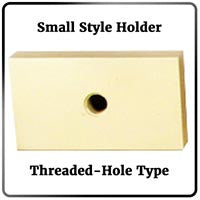 Small Style Holder: 3/8-16 Threaded Hole
For use with our standard fire-heated handle and electric heating tools ranging from 120W-200W. Select electric heating tools are available in 120V or 220V-240V.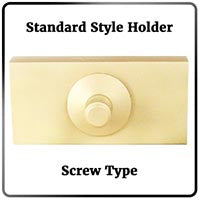 Standard Style Holder: 5/8-11 Threaded Shank
For use with heavy-duty fire heated handle and electric heating tools ranging from 250W-350W. Select electric heating tools are available in 120V or 220V-240V.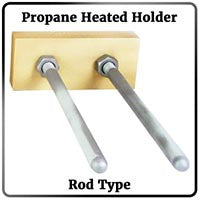 Propane Heated Holder: Rod Type
For use with the PRO-1000 Propane Heating Tool. -
Electric Branding Iron
An electric branding iron (excluding the electric cattle iron) is comprised of two main parts: The electric heating tool and the branding head (see Branding Head).
The branding head is connected to an electric heating tool where it is heated to a particular degree of heat. For best results, use with a temperature control unit (see Temperature Control Unit in "Basic Terms" tab). An electric heating tool is available in a variety of wattages. The required wattage is determined primarily by the size of the branding head. The larger the branding head, the higher the wattage. Some very large branding heads require two, three (or more) heating tools, for ensuring even heat distribution throughout the branding head. Most electric branding irons are available in both Handheld and Drill Press Mounting Models for greater efficiency.
Propane Branding Iron
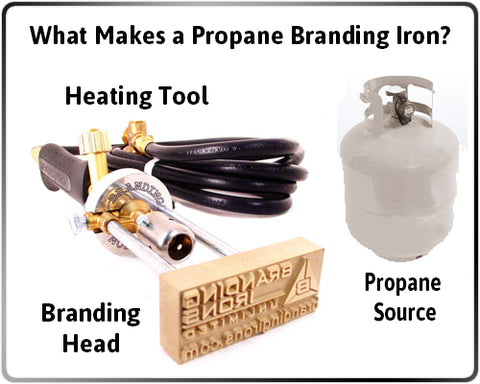
A propane branding iron is comprised of three major elements: The propane heating tool, the branding head (see branding head) and the propane source.
A propane heating tool connects directly to a propane source such as a propane tank (not sold by BIU). The branding head is attached to two adjustable rods connected the burner, and heated up with an adjustable flame. With its regulating knob, the user can control the flame intensity of the propane branding iron much like a gas stove-top.
Steak Branding Irons
A steak branding iron is a small, hand-held iron that is usually one solid part. They have a stainless steel head that is connected by a rod and wooden handle. It is heated by open flame until it is hot enough to brand. The iron is then placed on a steak or food item until it leaves a mark.

-
Cattle branding irons are made up of parts that are permanently connected. The cattle iron is available in three varieties: Fire Heated, Electric and a Freeze brander.
A Fire Heated cattle brander is the traditional style of branding iron and the oldest method of branding in existence. It is composed of one solid long piece of metal with one end as the handle and the other as the branding head. The head is designed extra thick for the marking of livestock. They are heated over a fire until desired heat is met, then applied to the skin of an animal resulting in a branded mark.
An Electric Cattle Brander is the modern alternative to the traditional cattle brander. This brander’s head is made up of tubular electric elements (custom bent into the requested brand and braced with steel rods at all stress points). The head is permanently attached to the tool handle and fitted with an electric cord. The electric cattle brander is designed to reach the proper temperature in about ninety seconds and maintain constant even heat.
A Freeze Brander is similar to a fire-heated cattle branding iron, however it is intended to be frozen using either liquid nitrogen or a mixture of dry ice and alcohol. It is applied to the animal’s hide (shaved), for killing off the pigment-producing cells of the specific treated area. The animal will thereafter grow white hair where the brand was placed.
-
Outlined Image
The lines that surround the entire filled image. In other words, the outlines are all the borderlines inside and around the outer edges. For example, the inner and the outer circles make up the outlines of a doughnut.
Filled Image
Artwork for logos and designs that are filled in or “colored in”. For example, a child’s coloring book featuring the outlines of images to be filled with color. After they are colored, these images would be considered “filled images”. The same applies to artwork we receive for producing branding heads.
Outlined CharacterThe inner and outer boundary lines of a filled character. When do we use this term? When weighing the option of using just the outlines of the characters for the sake of improving the branded mark or for achieving a branded mark with a different look.
Filled Character (Standard)
When font characters (type styles of letters, digits, punctuation marks and symbols in any language) are black throughout, these are referred to as “filled characters”.

-
Raster Image
Graphic files consisting of or containing a digital image which is a 2-D array of pixels (picture elements). In other words, a raster image is a digital image that was captured as a photograph or a scan or was created by using a raster graphics software program such as Photoshop.
A raster image can vary in its resolution but even a high resolution raster image can easily be identified by simply zooming in on it. When zooming in on a raster graphic the pixels making it up will be revealed. Examples of raster image file types are: BMP, TIFF, GIF, and JPG files.
When do we use the term “Raster Image? This term identifies the kind of art files (such as those listed above) that cannot be used by computer engraving programs unless converted into vector art. (See Graphic Assistance)
Vector Image
Vector graphics is the use of geometrical primitives such as points, lines, curves and shapes or polygons, which are all based upon mathematical equations, to represent images in computer graphics. When an image has been created in vector format, it can be refined and modified without the risk of losing detail. Unlike JPEGs, GIFs, and BMP images, vector graphics are not made up of a grid of pixels. Instead, vector graphics are comprised of paths, which are defined by a start and end point, along with other points, curves, and angles along the way. A path can be a line, a square, a triangle, or a curved shape. These paths can be used to create simple drawings or complex diagrams. Paths are even used to define the characters of specific typefaces (any font). These paths are also the cutting or engraving and milling paths used by our computerized engraving programs. That is why any given vector image has to contain only the essential paths that make it up, with no overlapping vectors (lines, points, curves, angles), no loops or other “obstacles” that would interfere with the paths of the computerized engraving program.
Because vector-based images are not made up of a specific number of dots, they can be scaled to a larger size and not lose any image quality. In comparison, if you blow up a raster graphic, it will look blurry or “pixelated”. When you blow up a vector graphic, the edges of each object within the graphic stay smooth and clean. This makes vector graphics ideal for logos, which can be small enough to appear on small items, but can also be scaled to fill a billboard. Common types of vector graphics include Adobe Illustrator, Corel Draw, and EPS files.
Tips for Submitting Images
- Raster files such as .JPG, .TIF, .GIF, .BMP & .PSD should be of the highest quality possible.
- Vector files should be free of any raster images. An easy way of spotting raster art is to zoom in close and see if it becomes pixelated.
- Saving a file as a vector format such as EPS, AI or FH11, does not guarantee that the image will be in true vector format. If the document contains raster images, they need to be vectorized. An easy way to determine this is to preview the document in “outline” or “keyline” mode. In this mode, every outline will be a pathway for the engraving program.
NOTE: Whether your image file is in raster or vector format, we can accommodate you and our Graphics Department is available for assistance.

When a filled (“colored in”) image is provided (for producing flat face branding heads), area should be outlined and interior of image should be free of intersecting lines. (see example below)

When thin, lightweight lines are needed for branding heads (for example when marking plastics), the art file should be prepared with outlines. (See example below).

When a branding head is made for marking certain materials (plastics, etc.), the art file should be prepared with either the outlines of the image or as a center-line.
- We use this term to indicate the protrusion of the engraved image above the background surface of the branding head. Why do we use this term? The nature of the material you intend to brand will dictate the relief. In other words, for softer products, such as bread or steak, soft leather, foam, and certain kinds of rubber, the relief will be greater than the relief of a branding head made for marking wood and firm leather.

Beveling removes excess metal surrounding the image. We bevel ¼” from the top surface to prevent background marks as well as to allow for rocking the branding head without catching the edge of the blank on the material being branded.
-
We use this term when referring to the total length and width of a character, text or design. In other words, the total amount of filled (black) areas of the character(s), logo or a design art file intended for producing any single branding head = The total top horizontal surface area that will come in contact with the surface of the item that is branded.
When do we use this term? The total amount of black on any give image will become the surface area on the branding head that will come in contact with the surface of the product you intend to mark. Therefore, when choosing a font and preparing the art file for any solid metal block used for creating a branding head (brass or stainless steel) needs to be taken into consideration, as it may affect the dwell time and degree of heat that would be required for achieving quality branded marks. This is especially important when branding food, supple leather, plastics and other materials that are heat-sensitive.












